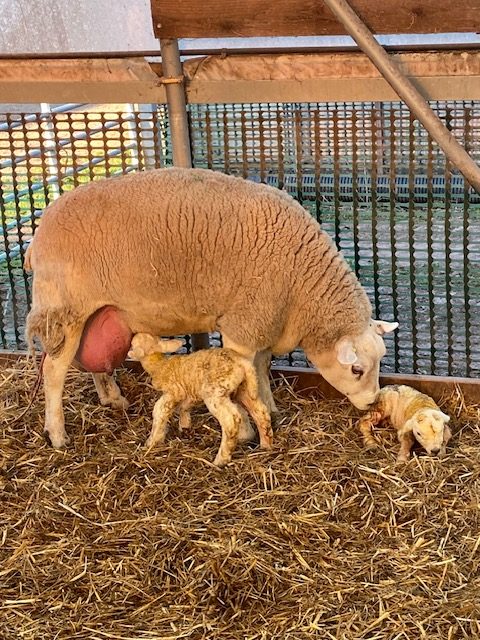
Lambing has continued at a pace, however the impact of the dry weather during the first tupping cycle in 2025 has meant that the usual 75% of ewes holding was reduced to around 50%.
Consequently this means more will be lambing in the second cycle than we would “normally” expect. This was caused by rain finally falling during the first cycle that made the grass green up, which was very welcomed. However it also means we have five time the number of triplets in the second cycle than the first!
Good mothering ability is critical for us and poor maternal ability is recorded and ewes are always culled from the flock.
We want ewes who lamb naturally, without intervention and who love their lambs! They also need to have plenty of milk and be attentive to their lambs when they are born, as this is critical to the health of the lambs and how they grow on.
Across the UK we have seen far greater use of Embryo Transfer work in Texel’s. This process sub contracts the carrying, birth and care of a lamb to another breed of ewe. If this trend continues over multiple female generations where donor ewes don’t lamb naturally, the selection for maternal traits is lost. This is something we feel is a retrograde step for the breed and is something that buyers should consider when making purchasing decisions.
Embryo transfer can be a great tool if you are trying to replicate a proven ewe who has excellent maternal traits but beware of anyone who solely uses it to produce their sale sheep as they will likely have lost control of the maternal ability of their females.
Fortunately iTexel https://www.itexel.uk/ allows you to see the birth type (embryo or natural) of all progeny and can help you be more informed about what you are buying, hopefully avoiding nasty surprises in the future.
You can be reassured that any Kimbolton sheep offered for sale will not have come from generations and generations of embryo bred sheep and that maternal ability is one of the strict selection criteria applied.