Those of you who know Paul will know that he is keen on data collection and evaluations, using the breeding values created to help make important management decisions.
So in addition to collecting the usual lambing ease, weight and scanning data, Paul has now provided to the Texel Sheep Society for the first time phenotypes for maternal ability and tail length.
It is hoped that these traits can be included in future evaluations so that they can better inform future breeding decisions.
The importance of maternal ability and lambing ease has been discussed in a previous post, however tail docking is something worth talking about as there is an industry debate underway currently.
For centuries, tail docking has been carried out to reduce the risk of fly strike and castration has been undertaken to prevent unplanned pregnancies when running mixed groups of lambs together.
For both tailing and castration the majority of farmers use rubber rings which are applied in the first seven days of life. Whilst this is effective it is not without pain and discomfort for the lamb, with the effects lasting for some time after application. This can affect growth rates as well as introduce wounds that bacteria can colonise and cause issues such as joint ill which are unpleasant for the lamb.
Animal health and welfare is of paramount importance to any farmer and when this is combined with the prospect of greater legislation it means alternative solutions need to be found and used.
So for the last two years Paul has successfully swapped from using a hot iron for tailing to the ClipFitter system. This is a clamp that is placed over the tail (or testicles) which when applied disables all cords and nerves resulting in significantly reduced discomfort for the lamb. Whilst this is more expensive than using rings it is a price worth paying as the lamb behaves normally once applied.
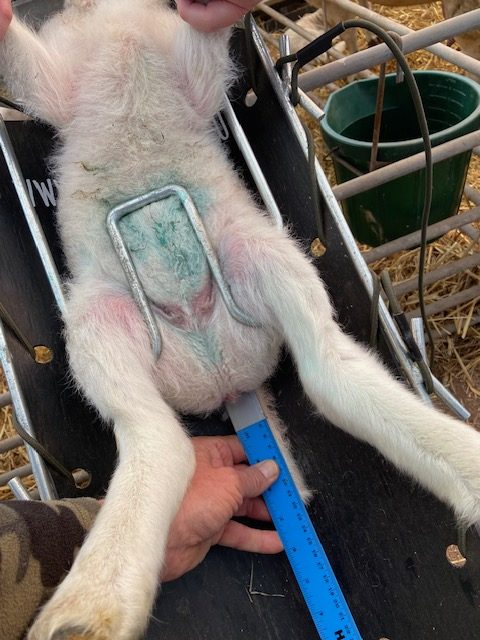
However there is a better natural solution – select rams that have naturally shorter tails as this would remove the need for any physical human intervention.
However to produce a breeding value for this many measurements or phenotypes need to be collected. This is undertaken within the first 24 hours of life, whilst other management tasks are done (eg ear tagging, weighing).
The picture below shows this taking place (note the wipe clean tape on the end of the ruler!!).